Choosing the right hardware can quietly change an entire kitchen, bathroom, hotel room, or office project. For global buyers, a Stainless Steel Cabinet Pull must offer more than a polished appearance. It should withstand repeated handling, humid rooms, cleaning chemicals, shipping pressure, and different installation habits.
Kitchen designer Susan Serra, CKD, has often described cabinet hardware as “the jewelry of the kitchen.” The comparison is useful, but incomplete. A pull is also a working component. Its metal grade, wall thickness, mounting strength, edge comfort, and surface treatment affect daily performance. This guide examines the 2026 options that balance appearance, durability, cost, and supply reliability.
Small details matter.
Many buyers prefer 304 stainless steel for general indoor applications. Coastal projects or highly corrosive environments may require a more careful review of 316 stainless steel. Brushed finishes can hide fingerprints, while mirror finishes reveal them quickly. Hole spacing must match the cabinet design, or installation becomes unnecessarily expensive. Packaging deserves attention too. A beautiful pull with scratched surfaces is not a successful purchase.
The market is not perfectly simple. “Stainless steel” can describe different grades, finishes, and manufacturing methods. Some low-cost products look convincing in photographs but feel thin in the hand. That weakness may appear months later. We will compare leading styles, dimensions, finishes, certifications, customization options, and supplier practices. The goal is practical confidence, not exaggerated promises, for distributors, contractors, designers, and buyers sourcing across international markets.
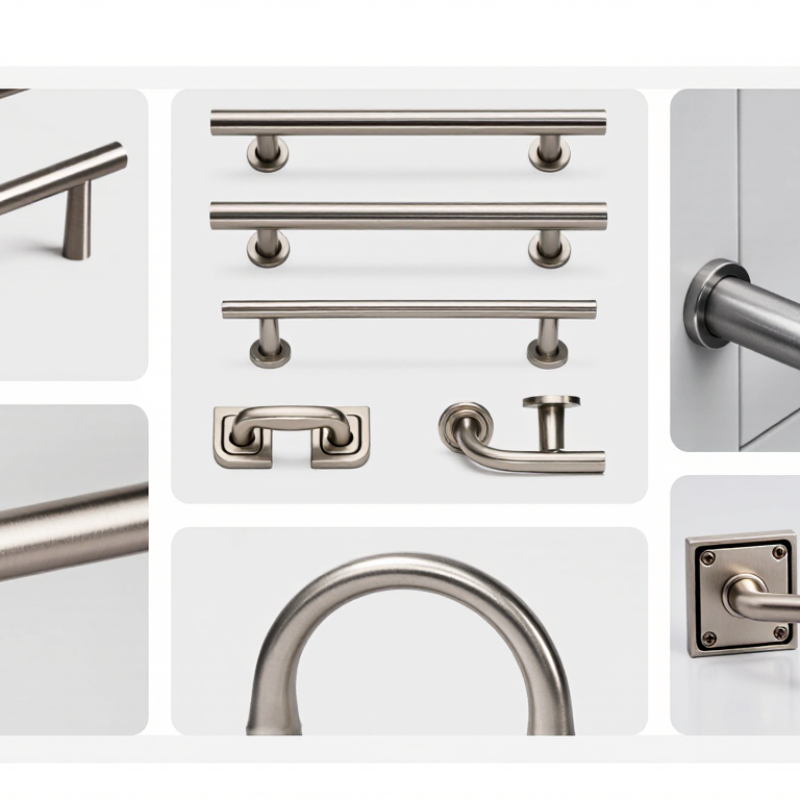
Stainless steel cabinet pulls begin with the alloy, not the surface finish. The World Stainless Association reported 58.4 million metric tonnes of crude stainless steel production in 2023. That scale reflects broad industrial use, but it does not make every grade suitable for every kitchen or bathroom.
Grade 304 remains a practical benchmark. It typically contains about 18% chromium and 8% nickel, supporting corrosion resistance and a clean, stable appearance. Grade 316 adds molybdenum, usually around 2–3%, which improves resistance to chlorides and coastal humidity. It costs more. Sometimes, the extra protection is unnecessary.
Grade 201 uses less nickel and more manganese. This can reduce material cost, yet performance may weaken in salty or poorly ventilated environments. Buyers should request mill certificates and confirm ASTM A240 or equivalent specifications. A polished surface can hide weak material. Look beyond shine.
Core features include solid mounting posts, accurate screw threads, rounded edges, and a consistent wall clearance. A pull should feel firm after repeated use, not rotate slightly in the hand. The ISO 9227 salt-spray standard can support comparative testing, but it does not perfectly reproduce household conditions. That limitation matters.
In my experience, installation quality often decides the result. Incorrect screw length can damage a cabinet or leave the pull unstable. Satin finishes hide fingerprints better than mirror finishes, but they still need gentle cleaning. Avoid chlorine-heavy cleaners. They may attack exposed metal over time. The cheapest specification is rarely the clearest decision.
Grade 304 suits many indoor kitchens and bathrooms. It contains roughly 18% chromium and 8% nickel. Good balance. Grade 316 offers stronger protection in coastal humidity, but costs more.
Not always. Grade 316 resists salt and moisture better because it contains molybdenum. For a dry indoor room, the extra cost may bring little benefit.
Grade 201 uses less nickel and more manganese. It may reduce cost, but salty or poorly ventilated spaces can expose weaknesses. A bright finish proves very little.
Request the exact steel grade, material certificates, batch records, screw material, and dimensional tolerances. Check the actual documents. Do not rely only on a polished sample.
Look for solid mounting posts, accurate threads, rounded edges, and consistent wall clearance. The pull should stay firm after repeated use. Slight rotation is a warning sign.
Pulls around 96 to 160 millimeters fit many standard drawers. Larger drawers may need longer handles or two smaller pulls. A grip depth of 25 to 35 millimeters often feels comfortable. Hand size still matters.
Measure the panel, nearby clearance, and cabinet thickness before drilling. Check screw length and thread compatibility. A paper template helps, but it can still mislead. Verify every hole before tightening.
Separate each pull with foam or recyclable sleeves. Seal screws in inner bags. Use moisture protection and drop-tested cartons. Overfilled cartons can still fail. Inspect random cartons for scratches, corrosion, missing screws, and incorrect labels.
Consider salt-spray testing, torque testing, coating adhesion checks, and repeated installation trials. These tests support comparison, but household conditions are different. Results are useful, not perfect.
Not necessarily. Returns, rework, damaged cartons, and customs delays can increase the real cost. Satin finishes hide fingerprints better than mirror finishes. Clean them gently, and avoid chlorine-heavy cleaners.
This 2026 guide helps global buyers evaluate stainless steel cabinet hardware with confidence. It explains how material composition and steel grades influence corrosion resistance, durability, appearance, and long-term value. Buyers will also learn how to compare pull length, center-to-center spacing, shape, edge treatment, grip comfort, and installation design to ensure the hardware fits both cabinet structure and user expectations. A well-designed Stainless Steel Cabinet Pull should provide reliable strength, a comfortable hand feel, and a finish that remains attractive in demanding environments.
The article also reviews practical pull styles for kitchens, bathrooms, offices, hospitality spaces, and other cabinet applications. For international sourcing, it highlights key purchasing considerations such as consistent quality, dimensional accuracy, surface inspection, secure packaging, clear product documentation, and dependable production communication. Finally, it presents a practical framework for comparing suppliers by assessing materials, manufacturing capability, customization support, sample quality, order consistency, delivery performance, and overall cost. This approach enables buyers to select suitable products and build more reliable cabinet hardware supply programs in 2026.

 Xianghui