Choosing the right Kitchen Cabinet Door Hinge in 2026 is no longer a minor hardware decision. It affects alignment, safety, noise, storage access, and daily comfort. A hinge may look small. Its workload is not.
Houzz’s 2024 U.S. Kitchen Trends Study reported that 76% of renovating homeowners upgraded their cabinets. The National Kitchen & Bath Association’s 2025 Kitchen Trends Report also highlights durability, accessibility, and functional storage. These findings point to a practical truth: cabinet performance depends on details users often overlook. A heavy solid-wood door needs stronger support than a lightweight slab door. Full-overlay, half-overlay, and inset doors also require different hinge geometries. Soft-close is valuable, but it does not repair poor installation.
“The kitchen is the heart of the home,” says Bill Darcy, former CEO of the National Kitchen & Bath Association. That statement explains why hinge selection deserves more attention. Every morning, a hinge may guide a cupboard door around plates, cookware, and crowded work zones. Small misalignment can create rubbing, uneven gaps, or premature wear. Annoying, but preventable.
This guide compares opening angles, load ratings, adjustment ranges, installation methods, and corrosion resistance. It also considers cabinet material and user habits. A frequently used pantry door deserves a different solution from a rarely opened display cabinet. Some product claims sound impressive. They still need testing. Manufacturer cycle ratings can vary, and real kitchens are not laboratories. The best choice balances verified specifications, installation experience, and honest assessment of long-term use.
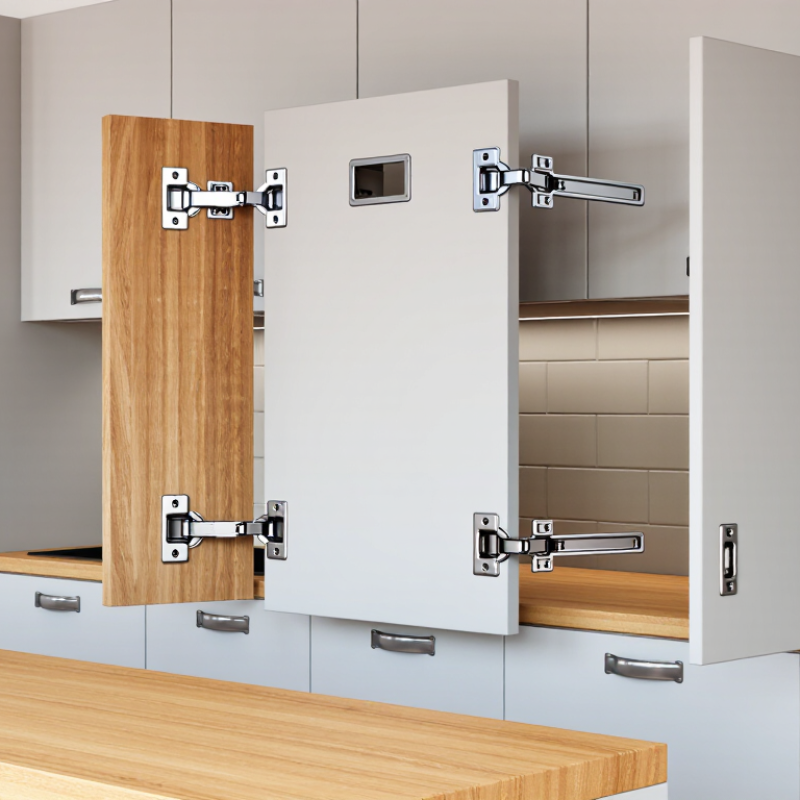
How to Choose the Right Kitchen Cabinet Door Hinge in 2026?
Kitchen Cabinet Door Hinges: Purpose, Types, and Essential Features
A cabinet hinge connects the door to its frame and controls every opening movement. It must carry the door’s weight without sagging, scraping, or creating uneven gaps. In daily use, a reliable hinge should feel smooth and remain quiet. Measure the door thickness, overlay, and cabinet construction before choosing a replacement. Small errors can cause large alignment problems.
Concealed hinges suit modern kitchens because they hide inside the cabinet and offer useful adjustments. Many models support side, height, and depth changes after installation. Face-frame cabinets and frameless cabinets may require different hinge plates. Butt hinges provide a traditional appearance, while pivot hinges work well for certain specialty doors. Select an opening angle that matches nearby walls, handles, and pull-out storage.
Soft-close control prevents doors from slamming and protects both hinges and cabinet boxes. Check the stated load rating, adjustment range, cup size, and tested cycle count. Stainless or corrosion-resistant materials are sensible near sinks and dishwashers. I once selected a hinge by appearance alone, and the door later rubbed against its neighbor. The finish looked right. The fit did not. Installation screws should grip solid material, not damaged particleboard. A level, a drill, and repeated gap checks improve accuracy. Still, even experienced installers can miss a slight cabinet twist. Recheck the alignment after several days of use.
The opening angle affects accessibility, clearance, and how far a cabinet door can swing from the cabinet box. Standard concealed European hinges commonly open to about 110°, while wide-angle hinges can reach approximately 155°. Butt hinges are often limited to around 90°, and continuous piano hinges may allow up to 180°, depending on the installation. Select a hinge according to the cabinet layout, door overlay, available clearance, load requirement, and whether soft-closing or three-way adjustment is needed.
How to Choose the Right Kitchen Cabinet Door Hinge in 2026?
Measure Cabinet Doors and Identify Your Installation Requirements
Accurate measurements should guide every hinge decision. Measure the door height, width, and thickness with a steel ruler. Record the overlay on all sides, not only the top edge. Measure twice. Do not guess.
Check whether the cabinet uses a face frame or frameless construction. Then inspect the existing hinge cup, mounting plate, screw positions, and door swing. A 35 mm cup is common, but verify the diameter and setback before drilling. The required opening angle also matters. A tight corner may need a wider-angle hinge, while adjacent doors may require a restricted model.
Door weight deserves careful attention. Include the handle, glass, and decorative panels. A practical installation assessment should consider hinge load capacity, adjustment range, soft-closing action, and cycle durability. ANSI/KCMA A161.1 provides cabinet performance benchmarks, but it does not replace the hinge manufacturer’s load instructions. Read both documents.
The 2024 Houzz U.S. Kitchen Trends Study reported that 76% of renovating homeowners upgraded their cabinets. That figure shows why replacement work demands reliable measurements, not assumptions. However, survey data describes homeowner behavior, not engineering performance. My own installation checks often reveal uneven walls and slightly twisted doors. That imperfect reality can change the final hinge choice. When measurements conflict, photograph the cabinet, test-fit one hinge, and reassess before drilling every door.
Choosing a cabinet hinge starts with overlay, not appearance. Full-overlay hinges cover nearly the entire cabinet side, creating clean, continuous door lines. Half-overlay hinges share a partition between two doors. Inset hinges place the door inside the cabinet frame, demanding tighter installation accuracy. The 2024 Houzz U.S. Kitchen Trends Study reports that 76% of renovated kitchens include upgraded cabinet doors or drawers, showing how heavily homeowners rely on precise hardware choices. Still, reports rarely explain the small installation errors that cause rubbing. A 1–2 millimeter gap can matter.
Opening angle affects daily movement. Standard hinges commonly open around 100–110 degrees, while wide-angle versions may reach 155–170 degrees. A wider opening helps when drawers sit beside doors or when corner cabinets need better access. However, it can increase contact with nearby walls. Measure the handle clearance first. Then check the actual door thickness and cabinet construction.
Mounting options also change the installation experience. Screw-on hinges offer direct adjustment but require accurate pilot holes. Clip-on hinges can speed installation and simplify later removal. Face-frame cabinets need compatible mounting plates, while frameless cabinets usually require concealed side-panel mounting. EN 15570 provides guidance for hinge durability and adjustment testing, but real kitchens remain less forgiving than laboratory doors. The Global Kitchen Cabinet Market, valued at approximately USD 88.6 billion in 2023 by Grand View Research, reflects a large and varied installation environment. One choice still gets overlooked: the opening angle may be correct, yet the handle can strike the adjacent wall.
| Hinge Configuration | Typical Door Overlay | Common Opening Angle | Mounting Option | Best Use Case | Main Advantages | Important Considerations |
|---|---|---|---|---|---|---|
| Full Overlay Concealed Hinge | Approximately 15–19 mm over the cabinet side, depending on the hinge and cabinet construction | Typically 100°–110° | Clip-on or screw-on mounting plate attached inside the cabinet | Frameless cabinets or face-frame cabinets where the door covers nearly all of the cabinet side | Creates a clean, continuous exterior appearance and hides most hardware when the door is closed | Requires accurate overlay measurement and sufficient clearance between adjacent doors and drawers |
| Half Overlay Concealed Hinge | Usually about half of the cabinet-side width; commonly used when two doors share one partition | Typically 100°–110° | Clip-on or screw-on mounting plate | Cabinet runs in which two doors are mounted on opposite sides of a central partition | Allows two doors to share a narrower cabinet partition while maintaining concealed operation | Overlay depends on the partition width, door thickness, and hinge model; measure both doors before ordering |
| Inset Concealed Hinge | 0 mm face overlay; the door sits inside the cabinet opening | Typically 95°–110° | Mounting plate fixed inside the cabinet, often with a face-frame adapter when required | Traditional or custom cabinets with doors fitted flush inside the cabinet opening | Provides a precise, furniture-style appearance and keeps the door within the cabinet profile | Needs accurate reveals on all sides; cabinet squareness and door alignment are especially important |
| Wide-Angle Concealed Hinge | Full, half, or inset overlay depending on the hinge cup and mounting plate | Approximately 155°–180° | Usually screw-on or clip-on mounting plate with a wide-angle hinge arm | Corner cabinets, pull-out shelves, and areas where broad access is more important than compact clearance | Improves access to cabinet contents and can reduce obstruction near cabinet corners | Check door-to-door clearance, adjacent wall clearance, and the manufacturer’s minimum cabinet-side requirements |
| Face-Frame Concealed Hinge | Full, half, or inset overlay selected with the appropriate mounting plate | Typically 100°–110°; wide-angle versions are also available | Face-frame adapter plate secured to the front frame, or a frame-specific hinge system | Cabinets with a visible front frame around the cabinet opening | Designed to accommodate the front frame and can simplify alignment on framed cabinet boxes | The face-frame width and frame position must match the hinge’s mounting range |
| Frameless Concealed Hinge | Commonly full overlay, half overlay, or inset | Typically 100°–110°; wide-angle versions may open farther | Mounting plate screwed directly to the cabinet side panel | European-style cabinets with uninterrupted cabinet sides and no front frame | Offers broad adjustment options and a streamlined appearance for modern cabinetry | Confirm the cabinet-side thickness, cup-bore position, and required overlay before installation |
| Soft-Closing Concealed Hinge | Available in full overlay, half overlay, and inset configurations | Commonly 100°–110°; some wide-angle versions open farther | Clip-on or screw-on mounting plate with an integrated damping mechanism | Most frequently used kitchen doors where reduced closing noise and controlled movement are desired | Slows the door near closing, helping reduce slamming and impact on the cabinet | Verify compatibility with the door weight and thickness; very light doors may require a suitable hinge force |
| Push-to-Open Concealed Hinge | Full overlay, half overlay, or inset, depending on the hinge system | Typically 100°–110° | Concealed hinge combined with a push-to-open catch or integrated opening mechanism | Handle-free kitchens and minimalist cabinet designs | Supports a handleless appearance and allows the door to be opened by pressing the front | Door gaps, catch position, and cabinet rigidity must be carefully set to prevent accidental opening or poor release |
| Traditional Butt Hinge | Usually mounted on the door edge; overlay is determined by the hinge position and cabinet design | Often about 90°–180°, depending on the hinge geometry and installation | Surface-mounted or mortised into the door and cabinet frame | Period-style, face-frame, or furniture-inspired cabinetry where visible hardware is part of the design | Simple construction, broad decorative choices, and suitability for many solid-wood cabinet styles | Usually visible when the door is closed and may require more precise mortising and alignment |
| Piano or Continuous Hinge | Not generally selected by overlay category; mounted along much of the door height | Often close to 180°, subject to the hinge knuckle and surrounding clearance | Surface-mounted or recessed along the door and cabinet edge | Specialty cabinet doors, narrow doors, or applications needing load distribution along the full edge | Distributes door weight over a long length and can reduce localized stress at individual hinge points | Less concealed than modern cup hinges and requires a straight, accurately aligned installation |
Cabinet hinges deserve more attention than their small size suggests. The 2024 Houzz U.S. Kitchen Trends Study reports that 76% of renovating homeowners replaced all their cabinets. That scale makes hinge selection a practical durability decision. For humid kitchens, choose corrosion-resistant stainless steel or nickel-plated steel. Zinc alloys can work, but surface quality varies between suppliers. I have seen attractive finishes fail early near dishwashers.
Adjustability matters during installation and later maintenance. Three-way hinges usually control height, depth, and side movement. This helps correct uneven gaps after seasonal cabinet movement. A 2-millimeter adjustment can prevent a door from rubbing against its neighbor.
Check overlay measurements carefully. A wrong overlay creates headaches, even with excellent hardware.
Soft-close hinges reduce slamming and protect cabinet frames. They also make busy kitchens noticeably quieter. Select dampers designed for the door’s weight, not only its size. The 2024 NKBA Kitchen Trends Report continues to emphasize practical storage and user-friendly kitchen functions.
Load capacity should include the door, handle, and stored accessories. For tall solid-wood doors, choose reinforced hinges with tested cycle performance. Look for documentation referencing recognized cabinet-hardware performance standards. Cheap hinges may pass a showroom test, yet struggle after thousands of openings. That uncomfortable possibility deserves attention.
Cabinet style should guide the hinge choice. Full-overlay doors need concealed hinges with adjustable depth and side movement. Inset doors need tighter alignment and more precise installation. Face-frame cabinets may require a different mounting plate than frameless boxes. Check the door thickness, weight, opening angle, and clearance before ordering. A soft-close mechanism suits quiet homes, but it adds cost and another part that can fail.
Budget matters, but replacement labor matters more. The 2024 Houzz U.S. Kitchen Trends Study reported that 76% of renovating homeowners upgraded their cabinet doors or fronts. That volume reflects a practical issue: many homeowners replace visible parts while keeping the cabinet boxes. Choose hinges with accessible adjustment screws and replaceable mounting hardware. Industry reports from the National Kitchen & Bath Association also continue to identify durability and storage usability as major kitchen priorities. These reports do not measure hinge performance directly, so treat them as planning context, not proof.
Tips: Count every hinge before buying. Use two hinges for light doors and three for tall or heavy doors, following the maker’s load rating. Wipe hinge cups with a dry cloth, and inspect loose screws twice yearly. I once matched a hinge by appearance alone. The door sagged within months. That small mistake taught me to measure first, especially on older cabinets with uneven frames. Cheap hinges can work, but poor adjustment quickly becomes visible around a bright white door.
Full-overlay hinges cover most of the cabinet side. Half-overlay hinges share a partition between two doors. Inset hinges place the door inside the frame. Inset installation needs very accurate alignment.
Standard hinges usually open about 100–110 degrees. Wide-angle hinges may reach 155–170 degrees. Measure handle clearance before choosing. A wider angle can improve corner access but strike a nearby wall.
Measure door thickness, door weight, overlay, cabinet construction, and nearby clearances. Check the handle position too. A 1–2 millimeter gap can prevent rubbing. Small errors matter.
Screw-on hinges offer direct adjustment but need accurate pilot holes. Clip-on hinges install faster and remove easily. Clip-on systems can simplify later maintenance. Neither option fixes incorrect measurements.
Face-frame cabinets often need compatible mounting plates. Frameless cabinets usually use side-panel mounting. Check the cabinet structure before buying. Similar-looking hinges may not fit.
Light doors commonly use two hinges. Tall or heavy doors may need three. Follow the hinge’s load rating. I once relied on appearance alone. The door sagged within months.
Soft-close hinges reduce slamming and suit quieter homes. They cost more and include another part that can fail. Choose accessible adjustment screws. Quiet operation is useful, but not essential for every cabinet.
Wipe hinge cups with a dry cloth. Inspect loose screws twice yearly. Replace damaged mounting hardware when possible. A bright white door reveals poor adjustment quickly. I still sometimes overlook older, uneven frames.
Choosing the right Kitchen Cabinet Door Hinge is essential for smooth operation, reliable support, and a polished cabinet appearance. Start by measuring the door carefully and identifying its overlay, thickness, opening direction, and mounting space. Consider whether the cabinet requires concealed, semi-concealed, or surface-mounted hinges, and compare available opening angles to ensure doors can open comfortably without hitting nearby walls or cabinets.
The best hinge should match the cabinet’s style, usage frequency, and weight. Durable materials can improve service life, while adjustable designs make it easier to align doors during installation and future maintenance. Soft-close functions provide quieter, gentler closing, but they should be selected according to the door’s size and load capacity. Finally, balance performance, appearance, budget, and long-term maintenance needs to choose a hinge that delivers dependable function and complements the overall kitchen design.

Xianghui